
Automotive Service Technician Red Seal (310S) Exam Prep
Built by tradespeople. Matched to the National Occupational Analysis. Ready for apprentices and trade qualifiers.
750 practice questions across 6 full-length tests
Matched to the Oil Heat System Technician NOA
Detailed answer explanations — not just an answer key
Canadian exam simulation in every test
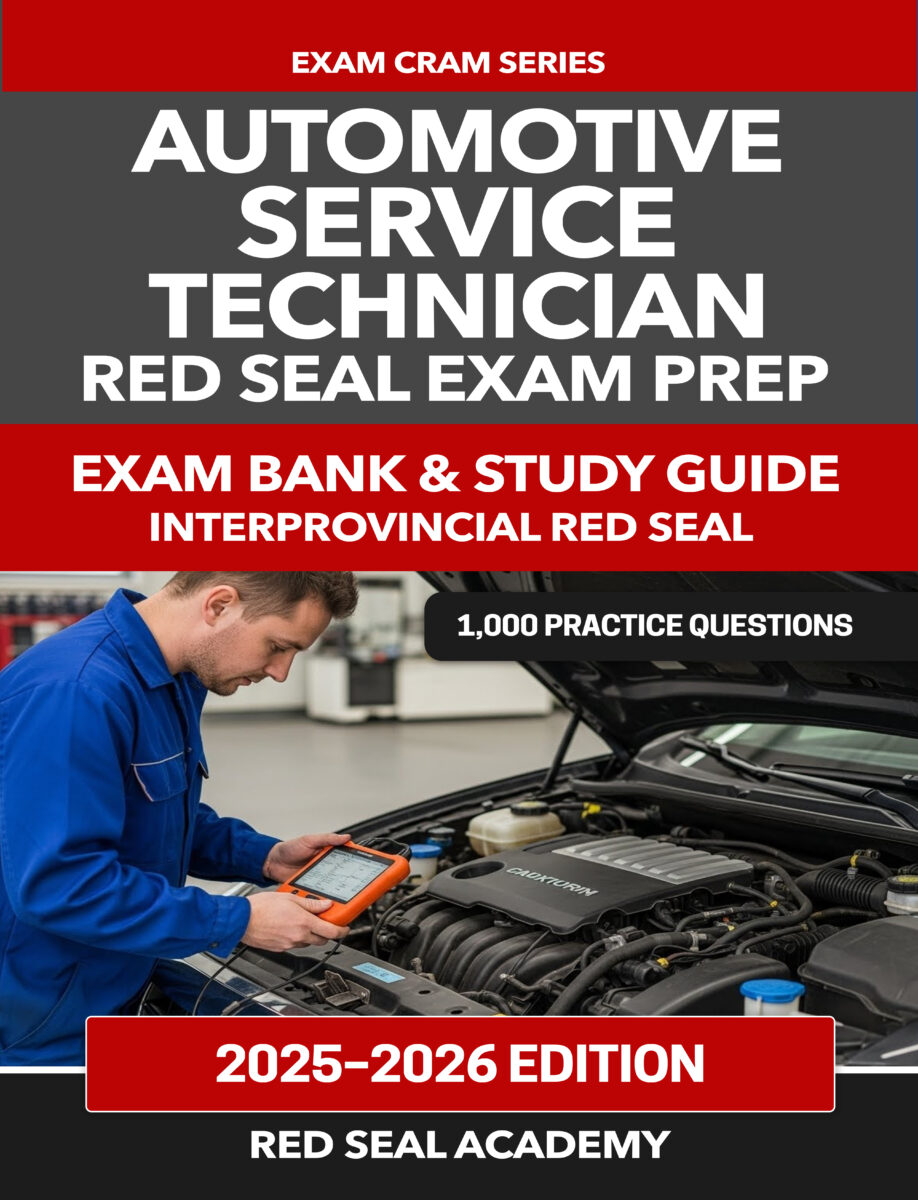
The Automotive Service Technician Red Seal exam has 150 multiple-choice questions. The questions are split across six Major Work Activities (MWAs) from the Automotive Service Technician National Occupational Analysis. The table below shows how the questions are split. Our book follows the same structure so your study time matches the real exam.
| Knowledge Domain / Major Work Activity | Number of Questions |
|---|---|
| A — Performs common occupational skills B — Diagnoses and repairs engine systems C — Diagnoses and repairs drive train systems D — Diagnoses and repairs electrical, electronic and emission control systems E — Diagnoses and repairs suspension, steering, brake and chassis systems F — Diagnoses and repairs heating, ventilation and air conditioning systems Total | 20 30 27 31 27 15 150 |
Source: Red Seal Occupational Standard for Automotive Service Technician (red-seal.ca). This is a study aid. Red Seal Training Academy is not affiliated with the Red Seal Program.
Which Path Are You On?
Apprentice writing the IP exam
You have finished your technical training and are booked to write the Interprovincial (IP) exam. Use our 8 full-length tests to pace yourself, find weak areas, and walk in ready.
Trade Qualifier / Challenger
You have around 7,200 hours of documented work experience but did not go through the apprenticeship schooling. You plan to challenge the Red Seal exam through your provincial Trade Equivalency Assessment. Our book covers the full NOA so you can close the gaps before exam day.
Rewriting after a previous attempt
If your last attempt did not go the way you wanted, use our detailed answer explanations to fix the knowledge gaps, not just memorize answers. Every question in the book has a written explanation.
Try 3 Free Sample Questions
One question of each type you will see on the real exam. Scroll to see the answer and explanation.
What is the purpose of the EGR (exhaust gas recirculation) valve?
A. To increase engine power under wide-open throttle
B. To reduce NOx emissions by lowering peak combustion temperature
C. To purge fuel vapours from the evaporative emissions canister
D. To reduce unburned hydrocarbon emissions
Answer: B
Explanation:
The EGR valve recirculates a measured portion of exhaust gas back into the intake. The exhaust gas is inert and lowers the peak combustion temperature, which reduces the formation of oxides of nitrogen (NOx). NOx forms at combustion temperatures above about 2500 degrees F. EGR is most active at part-throttle, not wide-open throttle.
When bleeding a hydraulic brake system, what is the correct sequence of wheels for a typical diagonally split system?
A. Left front, right front, left rear, right rear
B. Right rear, left rear, right front, left front
C. Start with the caliper farthest from the master cylinder and work toward the nearest
D. Any order, as long as all four are bled
Answer: C
Explanation:
Best practice is to bleed starting with the caliper farthest from the master cylinder (usually right rear) and working toward the closest. This purges air from the longest line first. Always follow the manufacturer’s service manual — some vehicles with electronic brake systems (ABS, stability control) require a specific bleed order and a scan tool to cycle the valves.
A vehicle has a P0300 random misfire code. Spark plugs, coils, and fuel injectors have been tested and are good. Fuel pressure is within specification. Compression is equal across all cylinders. What should be checked next?
A. Replace the ECM
B. Check for vacuum leaks and inspect the PCV system
C. Replace the camshaft position sensor
D. Clean the throttle body
Answer: B
Explanation:
A random misfire (P0300, not cylinder-specific) with good plugs, coils, injectors, compression, and fuel pressure most commonly points to a vacuum leak that affects all cylinders together. Inspect intake manifold gaskets, throttle body base gasket, PCV hose, and vacuum lines. Use a smoke test or propane test to find small leaks. Cylinder-specific codes (P0301-P0308) would point to individual cylinder components.
Our book has 1,000 questions like these, with an explanation for every one.
Automotive Service Technician Red Seal Exam — Frequently Asked Questions
What is the Red Seal Automotive Service Technician exam?
The Red Seal AST exam is the national trade certification exam for automotive service technicians in Canada. It tests the knowledge listed in the AST Red Seal Occupational Standard. When you pass, you receive the Red Seal endorsement on your provincial Certificate of Qualification. This lets you work as a journeyperson AST in any province or territory in Canada without re-certifying.
How many questions are on the 310S exam?
The exam has 150 multiple-choice questions. Each question has one correct answer out of four options. The questions are split across the six Major Work Activities in the National Occupational Analysis.
What is the pass mark?
The pass mark is 70%. You need to answer at least 105 out of 150 questions correctly to pass.
How long do I get to write the exam?
You are given 4 hours to write the exam. Most candidates finish before the time is up.
Can I challenge the exam without an apprenticeship?
Yes, in most provinces. You need to show around 7,200 hours of documented work experience in the trade through your provincial apprenticeship body. This route is called Trade Qualifier (TQ) or Trade Equivalency Assessment. Check the rules in your province before you apply.
Is the 310S exam the same as the Ontario 310S exam?
Yes. 310S is the Ontario exam code for Automotive Service Technician, and the Ontario exam is the Red Seal exam. Passing the Ontario 310S earns you both your Ontario Certificate of Qualification and the Red Seal endorsement in one sitting.