
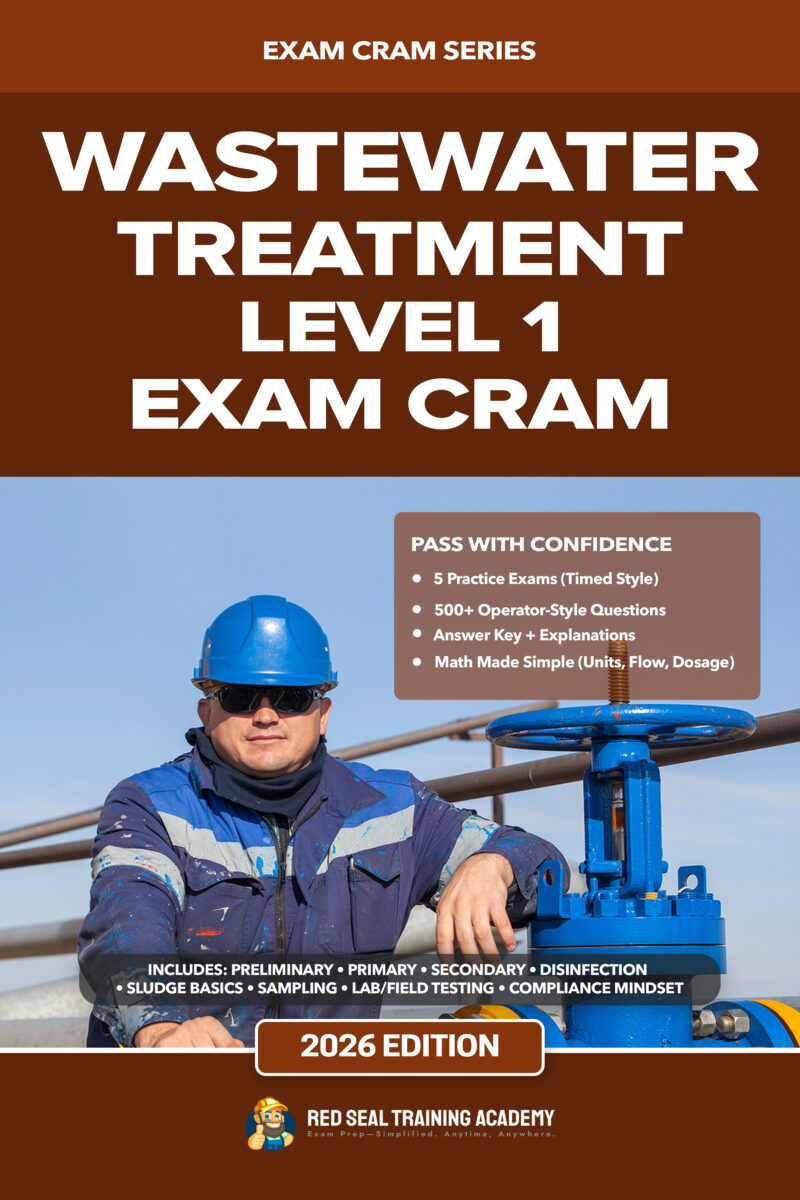
Wastewater Treatment Level 1 Operator Exam Prep
500 practice questions across 4 full-length tests
Aligned to ABC Need-to-Know Criteria for Wastewater Treatment
Detailed answer explanations — not just an answer key
Both SI and US units throughout, to match Canadian exam sittings
The Wastewater Treatment Level 1 exam is administered in BC by the Environmental Operators Certification Program (EOCP) using the standardized Association of Boards of Certification (ABC) exam. The exam has 100 multiple-choice questions covering the core domains below. Our book follows the same structure so your study time matches the real exam.
| Knowledge Domain / Major Work Activity | Number of Questions |
|---|---|
| Preliminary and primary treatment (screens, grit, clarifiers) Secondary treatment (activated sludge, trickling filters, RBCs) Disinfection and effluent discharge Solids handling (digestion, dewatering, disposal) Sampling, testing and process control Safety and regulations Calculations, hydraulics and chemistry Total | 15% 20% 12% 15% 14% 12% 12% 100% |
Source: ABC Need-to-Know Criteria for Wastewater Treatment, administered in Canada through EOCP and other provincial bodies. This is a study aid. Red Seal Training Academy is not affiliated with EOCP or ABC.
Which Path Are You On?
OIT writing the Level 1 exam
You hold your Operator-in-Training (OIT) certification and now need to pass the Level 1 exam to become a certified Wastewater Treatment Operator. Use our 4 full-length tests to pace yourself and walk in ready.
Municipal worker building a career path
You work in a wastewater treatment plant and want to formalize your knowledge with a Level 1 ticket. This prep book covers the full ABC domain so you learn the right material once and keep it as a reference.
Rewriting after a previous attempt
If your last attempt did not go the way you wanted, use our detailed answer explanations to fix the knowledge gaps, not just memorize answers. Every question in the book has a written explanation.
Try 3 Free Sample Questions
One question of each type you will see on the real exam. Scroll to see the answer and explanation.
In the activated sludge process, what does MLSS stand for?
A. Minimum Liquid Solids Specification
B. Mixed Liquor Suspended Solids
C. Mean Line Settleable Solids
D. Mixed Load Sludge Supply
Answer: B
Explanation:
MLSS stands for Mixed Liquor Suspended Solids — the concentration of suspended solids (biomass plus inert material) in the aeration tank, measured in mg/L. MLSS is a key process control parameter used to calculate F/M ratio and SRT (sludge retention time). Typical MLSS for conventional activated sludge is 1,500-4,000 mg/L.
A settleable solids test on the aeration tank (30-minute SSV) shows a settled volume of 400 mL in a 1-litre cylinder. MLSS is measured at 2,000 mg/L. What is the sludge volume index (SVI)?
A. 100 mL/g
B. 150 mL/g
C. 200 mL/g
D. 400 mL/g
Answer: C
Explanation:
SVI = (SSV30 in mL/L x 1,000) / MLSS in mg/L = (400 x 1,000) / 2,000 = 200 mL/g. SVI describes how well the sludge settles. Values of 80-150 mL/g indicate good settling; above 200 mL/g indicates bulking (often due to filamentous organisms); below 50 mL/g indicates pin floc. This is a core Level 1 calculation.
The secondary clarifier effluent is becoming cloudy and BOD is rising. MLSS in the aeration tank has increased. F/M ratio is below typical range. What is the most likely cause?
A. Sludge age too long, causing old sludge and pin floc
B. Inadequate dissolved oxygen
C. Industrial toxic shock
D. Hydraulic overload
Answer: A
Explanation:
White smoke on cold start combined with hard starting and rough running until the engine warms up is a classic low-compression symptom. Cold cylinders can’t compress the air enough to ignite the fuel reliably; once the cylinders warm, expansion of the rings and components improves compression and combustion. Glow plugs and grid heaters are confirmed good. A compression test on each cylinder is the next diagnostic step.
Our book has 520 questions like these, with an explanation for every one.
Wastewater Treatment Operator EOCP Exam — Frequently Asked Questions
What is the Wastewater Treatment Level 1 certification?
The Wastewater Treatment Level 1 certification is the entry-level professional ticket for operators who operate and maintain wastewater treatment plants. It is issued in BC by the Environmental Operators Certification Program (EOCP) and in other jurisdictions by the equivalent provincial certification body, all using the standardized ABC exam.
How many questions are on the Level 1 exam?
The ABC Level 1 Wastewater Treatment exam has 100 multiple-choice questions. Each question has one correct answer out of four options.
What is the pass mark?
The pass mark is 70%. You need to answer at least 70 out of 100 questions correctly to pass.
How long do I get to write the exam?
You are given 3 hours to write the exam. Most candidates finish well before the time is up.
Do I need work experience before I can write the exam?
Yes. Most jurisdictions require the Operator-in-Training (OIT) certificate plus documented experience in wastewater treatment (typically one year for Level 1). Check your provincial certification body for exact requirements.
Can I bring my own notes or a calculator into the exam?
The exam is closed-book. A formula sheet and conversion table are provided at the exam sitting. A non-programmable calculator is allowed. Confirm with EOCP or your provincial body before exam day.