
Plumber U.S. Journeyman Exam Prep
Built by tradespeople. Aligned to UPC and IPC plumbing codes. Ready for journeyman licensing across U.S. jurisdictions.
1,000 practice questions across 8 full-length tests
Coverage for both Uniform Plumbing Code (UPC) and International Plumbing Code (IPC) jurisdictions
Detailed answer explanations — not just an answer key
U.S. units and ASME / AWS standards throughout
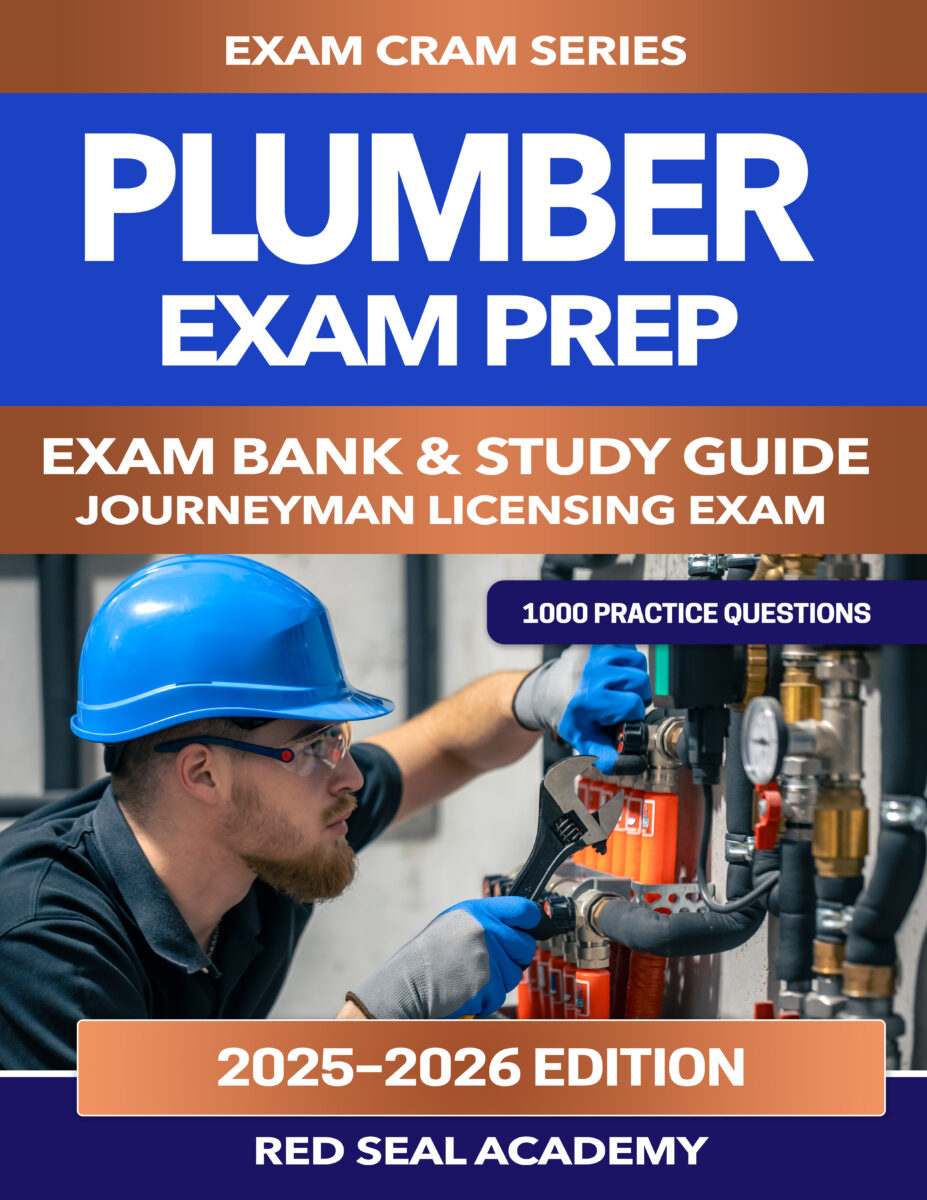
The U.S. journeyman plumber exam tests knowledge of the plumbing code adopted by your state — most commonly the Uniform Plumbing Code (UPC, used in western states) or the International Plumbing Code (IPC, used in most other states). The domains below cover the typical exam content. Our book follows the same structure so your study time matches the assessment.
| Knowledge Domain / Major Work Activity | Number of Questions |
|---|---|
| General regulations and definitions
DWV: drains, wastes and vents Water supply, distribution and water heaters Fixtures, fittings and traps Gas piping (NFPA 54 / IFGC) Sanitary drainage, storm drainage, and grease interceptors Backflow prevention and cross-connection control Calculations, sizing and isometrics Total | 10% 20% 18% 15% 10% 10% 8% 9% 100% |
Source: Uniform Plumbing Code (IAPMO UPC) and International Plumbing Code (ICC IPC). State amendments vary. This is a study aid. Red Seal Training Academy is not affiliated with IAPMO, ICC, or any state plumbing licensing authority.
Which Path Are You On?
Apprentice writing the journeyman exam
You have completed your apprenticeship hours and are sitting the journeyman plumber license exam. Use our 8 full-length tests to drill the code under exam conditions.
Trade qualifier or out-of-state transfer
You hold a journeyman license in one state and need to pass another state’s exam through reciprocity or full re-testing. Our book covers both UPC and IPC content so you can prepare for any U.S. jurisdiction.
Re-testing after a previous attempt
If your last attempt did not go the way you wanted, use our detailed answer explanations to fix the knowledge gaps, not just memorize answers. Every question in the book has a written explanation.
Try 3 Free Sample Questions
One question of each type you will see on the real exam. Scroll to see the answer and explanation.
Per the UPC, what is the maximum vertical distance a 2 inch trap arm can be located from the trap weir to the vent connection?
A. 3 feet 6 inches
B. 5 feet
C. 8 feet
D. 12 feet
Answer: C
Explanation:
Per UPC Table 1002.2, the maximum trap-to-vent distance for a 2 inch trap arm is 8 feet. The IPC limit is similar. This rule prevents the trap from being siphoned dry by a long trap arm. Different pipe sizes have different maximum distances — 1-1/4 inch is 3.5 feet, 1.5 inch is 5 feet, 2 inch is 8 feet, 3 inch is 10 feet, 4 inch is 12 feet (UPC values; verify the edition in force in your jurisdiction).
What is the minimum slope for a 4 inch building drain per the UPC?
A. 1/16 inch per foot
B. 1/8 inch per foot
C. 1/4 inch per foot
D. 1/2 inch per foot
Answer: B
Explanation:
Per UPC Table 717.1, the minimum slope for a 4 inch building drain is 1/8 inch per foot (1% slope). The IPC has the same minimum. Smaller pipes (3 inches and less) require 1/4 inch per foot. Too little slope lets solids settle out; too much slope lets water race ahead of solids. Both codes set 1/8 inch per foot as the floor for 4 inch and larger gravity drains.
A residential plumbing system has a hot water tank installed but no expansion tank. After hot water use, the relief valve drips for 5-10 minutes then stops. The relief valve is rated correctly. What is the most likely cause and best correction?
A. Faulty relief valve — replace it
B. Thermal expansion of heated water has nowhere to go — install an expansion tank
C. Air in the system — bleed at the highest fixture
D. Excess inlet pressure — reduce with a PRV
Answer: B
Explanation:
When a closed system (with a check valve, pressure regulator, or backflow preventer at the inlet) heats water, the water expands but cannot push back into the city main. Pressure rises until the relief valve opens. The standard fix is a properly sized expansion tank on the cold inlet to the water heater. Both UPC and IPC require expansion provisions on closed systems. Replacing the relief valve will not fix the underlying expansion issue.
Our book has 1,000 questions like these, with an explanation for every one.
Plumber (USA) UPC / IPC Exam — Frequently Asked Questions
What is the U.S. journeyman plumber license?
The U.S. journeyman plumber license is a state-issued credential that allows you to install and repair plumbing systems independently. Each state issues its own license and runs its own exam, but most exams test a base of UPC or IPC code knowledge, plus state-specific amendments. Some cities (Chicago, NYC) have additional municipal exams.
What is the difference between UPC and IPC?
Two competing model plumbing codes used across the U.S. The Uniform Plumbing Code (UPC) is published by IAPMO and used primarily in western states (California, Washington, Oregon, parts of Nevada, etc.). The International Plumbing Code (IPC) is published by the International Code Council (ICC) and used in most other states. The technical content is similar but article structure, terminology, and some specifics differ. Always confirm which code your state has adopted.
How many questions are on a typical journeyman exam?
Length varies by state. Most journeyman exams are 80-120 multiple-choice questions over 4-6 hours. Some states include a separate isometric or sizing problem section. Pass mark is typically 70-75%.
Can I take my license to another state?
Sometimes through reciprocity agreements, but most often you must pass the new state’s exam. A few states offer reciprocity to specific neighbors (NY-CT, AL-GA, etc.). Most do not. Check your destination state’s licensing board.
Do I need experience hours before I can write the exam?
Yes. Most states require 4,000-8,000 hours of documented apprenticeship work experience plus completion of a registered apprenticeship program before sitting the journeyman exam. Some states allow self-documented experience without a formal apprenticeship if you can provide pay stubs and a sponsor letter.
Do I need a master plumber license to own a plumbing business?
Yes, in most states. The master plumber license is the next step after journeyman and is typically required to hold a contracting license, pull permits, and supervise other plumbers. Master license requirements include additional experience hours plus a separate exam.