
Water Distribution Level 1 Operator Exam Prep
Built for municipal operators. Aligned to the ABC Need-to-Know Criteria. Ready for OIT graduates and Level 1 candidates.
500 practice questions across 4 full-length tests
Aligned to ABC Need-to-Know Criteria for Water Distribution
Detailed answer explanations — not just an answer key
Both SI and US units throughout, to match Canadian exam sittings
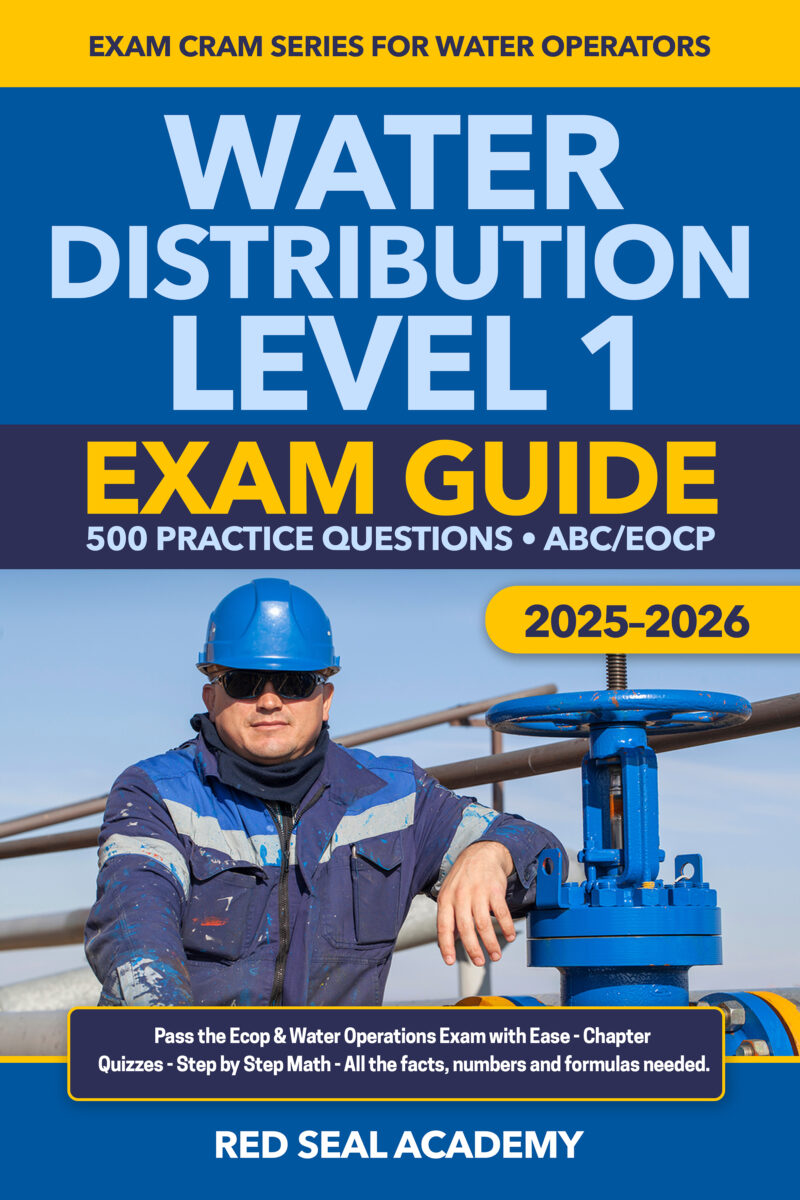
The Water Distribution Level 1 exam is administered in BC by the Environmental Operators Certification Program (EOCP) using the standardized Association of Boards of Certification (ABC) exam. The exam has 100 multiple-choice questions covering the core domains below. Our book follows the same structure so your study time matches the real exam.
| Knowledge Domain / Major Work Activity | Number of Questions |
|---|---|
| Water mains, services, valves and hydrants Storage facilities and reservoirs Pumps and pumping Disinfection and water quality Cross-connection control and backflow Safety, regulations and records Calculations, hydraulics and pressure Total | 20% 12% 12% 15% 10% 16% 15% 100% |
Source: ABC Need-to-Know Criteria for Water Distribution, administered in Canada through EOCP and other provincial bodies. This is a study aid. Red Seal Training Academy is not affiliated with EOCP or ABC.
Which Path Are You On?
OIT writing the Level 1 exam
You hold your Operator-in-Training (OIT) certification and now need to pass the Level 1 exam to become a certified Water Distribution Operator. Use our 4 full-length tests to pace yourself and walk in ready.
Municipal worker building a career path
You work in a municipal public works department and want to formalize your knowledge with a Level 1 ticket. This prep book covers the full ABC domain so you learn the right material once and keep it as a reference.
Rewriting after a previous attempt
If your last attempt did not go the way you wanted, use our detailed answer explanations to fix the knowledge gaps, not just memorize answers. Every question in the book has a written explanation.
Try 3 Free Sample Questions
One question of each type you will see on the real exam. Scroll to see the answer and explanation.
1)What is a cross-connection in a potable water system?
A. A physical connection between a potable and a non-potable water supply
B. A valve that connects two water mains
C. A branch connection at a service tap
D. A bypass around a pressure regulating valve
Answer: A
Explanation:
A cross-connection is any actual or potential physical connection between a potable (safe drinking) water system and a non-potable source that could allow contamination to flow backwards into the potable system. Cross-connection control is a core Level 1 competency and is managed using backflow prevention devices such as RPs, DCVAs, and AVBs.
2)The water level in an elevated tank is 30 metres above ground. What is the resulting static pressure at a tap at ground level?
A. 103.4 kPa
B. 224.1 kPa
C. 294.2 kPa
D. 517.1 kPa
Answer: C
Explanation:
Static pressure equals height of water multiplied by the pressure per metre of head. For water, 1 metre of head = 9.807 kPa. So 30 m x 9.807 kPa/m = 294.2 kPa. In US units, 30 m = 98.4 ft and 98.4 ft x 0.433 psi/ft = 42.6 psi. This is a Level 1 calculation fundamental.
A water distribution system is reporting a chlorine residual well below the system average at a dead-end hydrant. The operator flushes the hydrant and residual returns to normal. What was the most likely cause?
A. A broken chlorine feed pump at the treatment plant
B. Water age at the dead-end resulting in chlorine demand and residual decay
C. Cross-connection from a residential irrigation system
D. Over-dosing of chlorine at the feed point
Answer: B
Explanation:
Low chlorine residual at a dead-end that returns to normal after flushing points to water age. Water sitting in a dead-end main loses chlorine through demand (reactions with pipe wall biofilm, organics) and natural decay. Regular flushing of dead-ends is standard maintenance. Pump failure or over-dosing would affect residual system-wide, not just at one dead-end.
Our book has 500 questions like these, with an explanation for every one.
Water Distribution Operator EOCP Exam — Frequently Asked Questions
What is the Water Distribution Level 1 certification?
The Water Distribution Level 1 certification is the entry-level professional ticket for operators who install, maintain, and operate water distribution systems including water mains, storage, and service connections. It is issued in BC by the Environmental Operators Certification Program (EOCP) and in other jurisdictions by the equivalent provincial certification body, all using the standardized ABC exam.
How many questions are on the Level 1 exam?
The ABC Level 1 Water Distribution exam has 100 multiple-choice questions. Each question has one correct answer out of four options.
What is the pass mark?
The pass mark is 70%. You need to answer at least 70 out of 100 questions correctly to pass.
How long do I get to write the exam?
You are given 3 hours to write the exam. Most candidates finish well before the time is up.
Do I need work experience before I can write the exam?
Yes. Most jurisdictions require the Operator-in-Training (OIT) certificate plus documented experience in water distribution (typically one year for Level 1). Check your provincial certification body for exact requirements.
Can I bring my own notes or textbooks into the exam?
The exam is closed-book. A formula sheet and conversion table are provided at the exam sitting. A non-programmable calculator is allowed. Confirm with EOCP or your provincial body before exam day.