
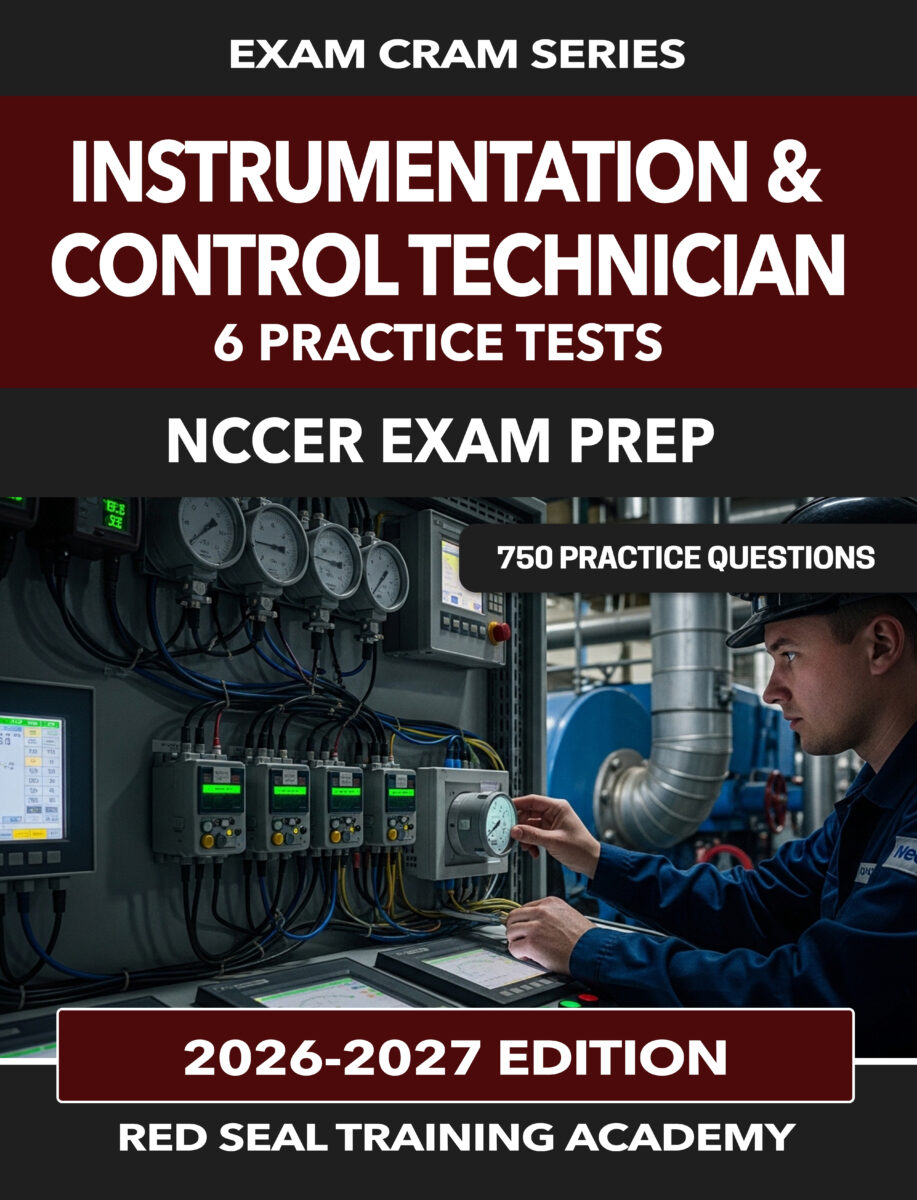
Instrumentation and Control Technician NCCER Exam Prep
Built by tradespeople. Aligned to the NCCER Instrumentation curriculum (Levels 1–4). Ready for apprentices, journeymen, and NCCER assessment candidates.
750 practice questions across 6 full-length tests
Aligned to NCCER Instrumentation Levels 1 through 4
Detailed answer explanations — not just an answer key
U.S. units and industry standards (ISA, ANSI, NEMA) throughout
The NCCER Instrumentation Certification exam is a Module End-of-Course (EOC) or Journey-Level Assessment covering the four-level NCCER Instrumentation curriculum. The exam is 100 to 140 multiple-choice questions depending on the assessment. The domains below represent the main knowledge areas. Our book follows the same structure so your study time matches the assessment.
| Knowledge Domain / Major Work Activity | Number of Questions |
|---|---|
| Safety, hand and power tools Process control theory and loop fundamentals Pressure, temperature, level and flow measurement Final control elements (valves, actuators, positioners) Instrument installation, tubing and wiring Calibration and loop checking PLCs, DCS and distributed control Documentation, P&IDs and loop sheets Total | 12% 14% 18% 12% 12% 14% 10% 8% 100% |
Source: NCCER Instrumentation Levels 1 through 4 curriculum. Exam length and exact weighting depend on whether the candidate writes the EOC modules or the Journey-Level Assessment. This is a study aid. Red Seal Training Academy is not affiliated with NCCER.
Which Path Are You On?
Apprentice finishing NCCER Level 3 or 4
You are working through the NCCER Instrumentation curriculum and want to build confidence for your module end-of-course exams. Use our 6 full-length tests to pace yourself and find weak areas.
Journey-Level Assessment candidate
You have the field experience and are preparing for the NCCER Journey-Level Instrumentation Assessment. Our book covers the breadth of Levels 1–4 so you can close knowledge gaps before the written exam and practical performance verification.
Re-testing after a previous attempt
If your last attempt did not go the way you wanted, use our detailed answer explanations to fix the knowledge gaps, not just memorize answers. Every question in the book has a written explanation.
Try 3 Free Sample Questions
One question of each type you will see on the real exam. Scroll to see the answer and explanation.
What does the ISA tag ‘PIC-101’ typically designate?
A. A pressure indicator only
B. A pressure indicating controller
C. A pump interlock circuit
D. A process inspection checkpoint
Answer: B
Explanation:
Per ISA-5.1 tagging standards: the first letter is the measured variable (P = Pressure), and subsequent letters describe the function — I = Indicating, C = Controlling. So PIC = Pressure Indicating Controller. The loop number (101) identifies the specific loop. Understanding ISA tagging is a fundamental NCCER Instrumentation Level 1 competency.
During a five-point calibration of a 4-20 mA pressure transmitter, the output reads 12.08 mA at 50% of range. What is the error?
A. 0.08 mA high
B. 0.08 mA low
C. 2 mA high
D. Within tolerance, no error
Answer: A
Explanation:
At 50% of range, the output should be 12.00 mA (midpoint of 4-20 mA). The actual reading is 12.08 mA, so the error is 0.08 mA high — approximately 0.5% of span (0.08 / 16 x 100). Whether this is within tolerance depends on the instrument spec (typically ±0.1% to ±0.5% of span). The correct error reporting is the direction (high) and magnitude (0.08 mA).
A DP flow transmitter on an orifice plate installation is reading 25% lower than expected. The orifice bore is confirmed correct and the DP transmitter has been calibrated. Upstream and downstream pressures are normal. What should be checked next?
A. Replace the DP transmitter
B. Check the impulse lines for blockage, leaks or trapped gas / liquid
C. Adjust the PID tuning on the flow controller
D. Replace the orifice plate
Answer: B
Explanation:
When a DP flow transmitter reads low despite correct calibration and confirmed orifice geometry, the most likely cause is an issue in the impulse lines: blockage from sediment, leaks to atmosphere, trapped gas in liquid service, or trapped liquid in gas service. Any of these reduces the differential pressure sensed by the transmitter. Systematic troubleshooting of the impulse lines is the next step before replacing components.
Our book has 750 questions like these, with an explanation for every one.
Instrumentation and Control Technician (NCCER) NCCER Exam — Frequently Asked Questions
What is the NCCER Instrumentation Certification?
The NCCER Instrumentation Certification recognizes mastery of the four-level NCCER Instrumentation curriculum. NCCER (National Center for Construction Education and Research) develops standardized craft training used across much of the U.S. construction and industrial workforce. Candidates complete module end-of-course exams during apprenticeship, or sit the Journey-Level Assessment as an experienced worker.
How many questions are on the NCCER Instrumentation assessment?
Module EOC exams vary by module (typically 25-40 questions each). The Journey-Level Assessment is 100-140 multiple-choice questions, plus a separate practical performance verification in most states and locals.
What is the pass mark?
Most NCCER exams require 70% or higher to pass. The Journey-Level Assessment may require higher scores on specific domains. Confirm with your Accredited Assessment Center.
Can I take the Journey-Level Assessment without completing the full NCCER apprenticeship?
Yes. The Journey-Level Assessment is designed for experienced workers who did not go through a formal NCCER apprenticeship. Candidates typically need documented field experience. Contact an Accredited Assessment Center for the exact requirements.
Is NCCER Instrumentation the same as ISA CCST?
No. NCCER and ISA CCST (Certified Control System Technician) are separate certifications. NCCER focuses on craft training through an apprenticeship model; ISA CCST is an experience-based certification aimed at working technicians. Many technicians hold both.
Is NCCER certification transferable across states?
Yes. NCCER credentials are nationally recognized across the United States and are accepted by many contractors in Canada and internationally. Your NCCER training records stay in the NCCER Registry for life.