
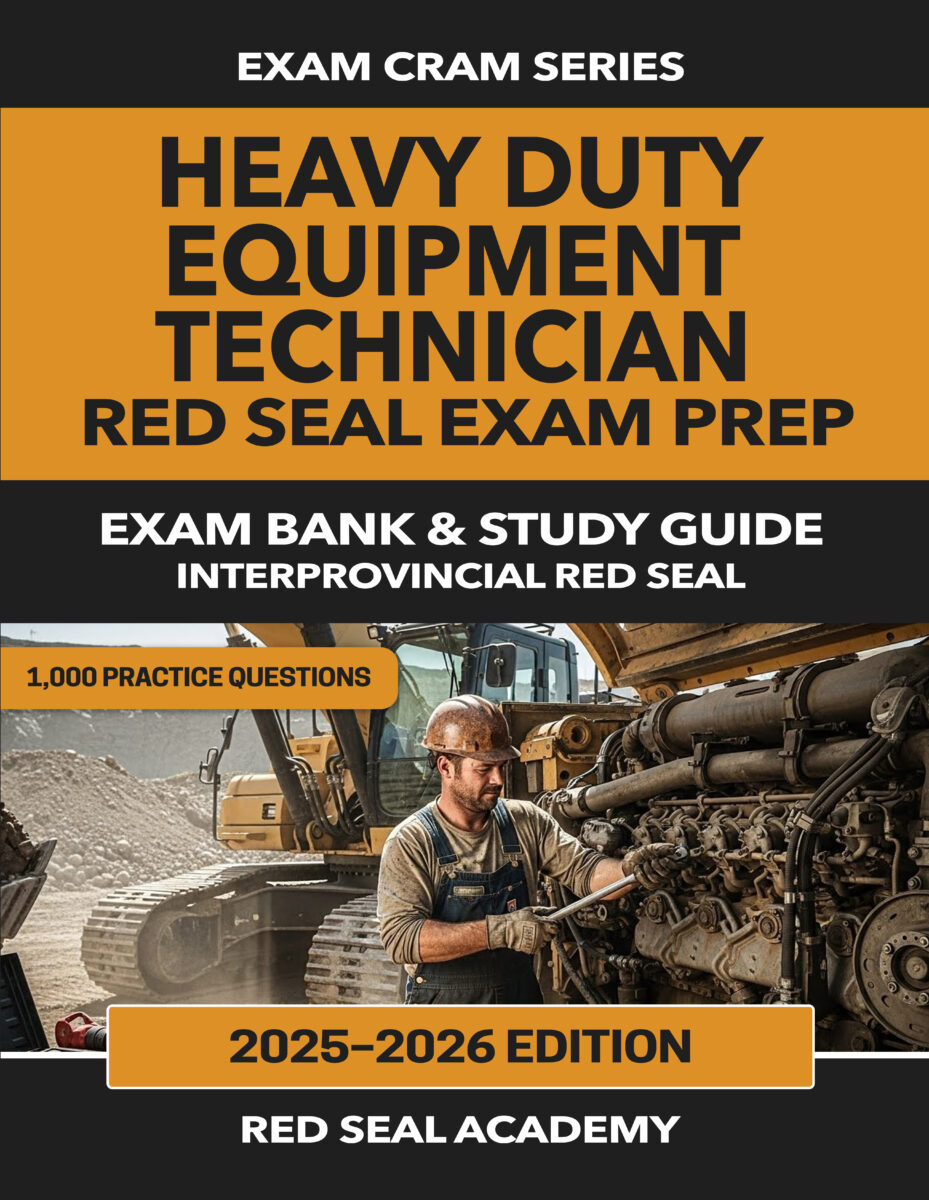
Heavy Duty Equipment Technician Red Seal (421A) Exam Prep
Built by tradespeople. Matched to the National Occupational Analysis. Ready for apprentices and trade qualifiers.
1,000 practice questions across 8 full-length tests
Matched to the Heavy Duty Equipment Technician NOA
Detailed answer explanations — not just an answer key
Canadian exam simulation in every test
The Heavy Duty Equipment Technician Red Seal exam has 135 multiple-choice questions. The questions are split across six Major Work Activities (MWAs) from the Heavy Duty Equipment Technician National Occupational Analysis. The table below shows how the questions are split. Our book follows the same structure so your study time matches the real exam.
| Knowledge Domain / Major Work Activity | Number of Questions |
|---|---|
| A — Performs common occupational skills B — Services engine systems C — Services drive train and undercarriage systems D — Services hydraulic and fluid power systems E — Services electrical and electronic systems F — Services steering, suspension, brakes, chassis, frames and attachments Total | 20 30 28 25 25 22 150 |
Source: Red Seal Occupational Standard for Heavy Duty Equipment Technician (red-seal.ca). This is a study aid. Red Seal Training Academy is not affiliated with the Red Seal Program.
Which Path Are You On?
Apprentice writing the IP exam
You have finished your technical training and are booked to write the Interprovincial (IP) exam. Use our 8 full-length tests to pace yourself, find weak areas, and walk in ready.
Trade Qualifier / Challenger
You have around 7,200 hours of documented work experience but did not go through the apprenticeship schooling. You plan to challenge the Red Seal exam through your provincial Trade Equivalency Assessment. Our book covers the full NOA so you can close the gaps before exam day.
Rewriting after a previous attempt
If your last attempt did not go the way you wanted, use our detailed answer explanations to fix the knowledge gaps, not just memorize answers. Every question in the book has a written explanation.
Try 3 Free Sample Questions
One question of each type you will see on the real exam. Scroll to see the answer and explanation.
What is the purpose of a pilot-operated check valve in a hydraulic system?
A. To limit maximum system pressure
B. To allow free flow in one direction and block reverse flow unless a pilot signal opens the valve
C. To reduce flow rate in a specific branch
D. To prevent cavitation in the pump
Answer: B
Explanation:
A pilot-operated check valve allows free flow in one direction (like a regular check valve) and blocks reverse flow — but can be opened in reverse by applying hydraulic pressure to a pilot port. This lets the valve hold loads (such as a lifted blade or bucket) securely but release them controllably when the operator commands movement. Common on boom, bucket, and outrigger circuits.
When installing a new track chain on a crawler dozer, what is the correct initial track sag specification?
A. Finger-tight, no measurable sag
B. Per the manufacturer specification, typically 25-50 mm (1-2 inches) of mid-span sag
C. Tight enough to eliminate all slack
D. As loose as possible to reduce bushing wear
Answer: B
Explanation:
Track sag is set per the manufacturer spec, typically 25-50 mm (1-2 inches) of mid-span sag depending on machine model and working conditions. Too tight accelerates bushing, pin, and sprocket wear and robs horsepower. Too loose allows the track to de-rail. Always measure per the service manual procedure on the specific model.
A hydraulic excavator’s boom drifts down when stopped mid-lift, even with the control lever in neutral. Pilot pressure, cylinder seals, and the main relief valve have all tested within spec. What is the most likely cause?
A. Worn pump
B. Failed boom-down cylinder seal
C. Internal leak past the holding valve / counterbalance valve on the boom cylinder
D. Low hydraulic fluid level
Answer: C
Explanation:
Boom drift with confirmed good cylinder seals, good pilot pressure, and a good relief valve points to internal leakage past the holding valve (counterbalance valve) that locks the cylinder when the control is in neutral. These valves can leak due to contamination damage on the spool, cracked seat, or a broken spring. Cylinder seal failure would show external leakage; a worn pump wouldn’t affect drift with the valve closed.
Our book has 1,000 questions like these, with an explanation for every one.
Heavy Duty Equipment Technician Red Seal Exam — Frequently Asked Questions
What is the Red Seal Heavy Duty Equipment Technician exam?
The Red Seal HDET exam is the national trade certification exam for heavy duty equipment technicians in Canada. It tests the knowledge listed in the HDET Red Seal Occupational Standard. When you pass, you receive the Red Seal endorsement on your provincial Certificate of Qualification. This lets you work as a journeyperson HDET in any province or territory in Canada without re-certifying.
How many questions are on the 421A exam?
The exam has 150 multiple-choice questions. Each question has one correct answer out of four options. The questions are split across the six Major Work Activities in the National Occupational Analysis.
What is the pass mark?
The pass mark is 70%. You need to answer at least 105 out of 150 questions correctly to pass.
How long do I get to write the exam?
You are given 4 hours to write the exam. Most candidates finish before the time is up.
Can I challenge the exam without an apprenticeship?
Yes, in most provinces. You need to show around 7,200 hours of documented work experience in the trade through your provincial apprenticeship body. This route is called Trade Qualifier (TQ) or Trade Equivalency Assessment. Check the rules in your province before you apply.
Is Heavy Duty Mechanic the same as Heavy Duty Equipment Technician?
The official Red Seal trade title is Heavy Duty Equipment Technician. Heavy Duty Mechanic is the common shop-floor and job-site name for the same trade. In Ontario the code is 421A; in Alberta and BC the trade is registered as HDET. They are the same Red Seal exam and the same journeyperson scope of practice.