
Millwright NCCER Exam Prep
Built by tradespeople. Aligned to the NCCER Millwright curriculum (Levels 1–4). Ready for apprentices, journeymen, and NCCER assessment candidates.
1,000 practice questions across 8 full-length tests
Aligned to NCCER Millwright Levels 1 through 4
Detailed answer explanations — not just an answer key
U.S. units and imperial measurements throughout
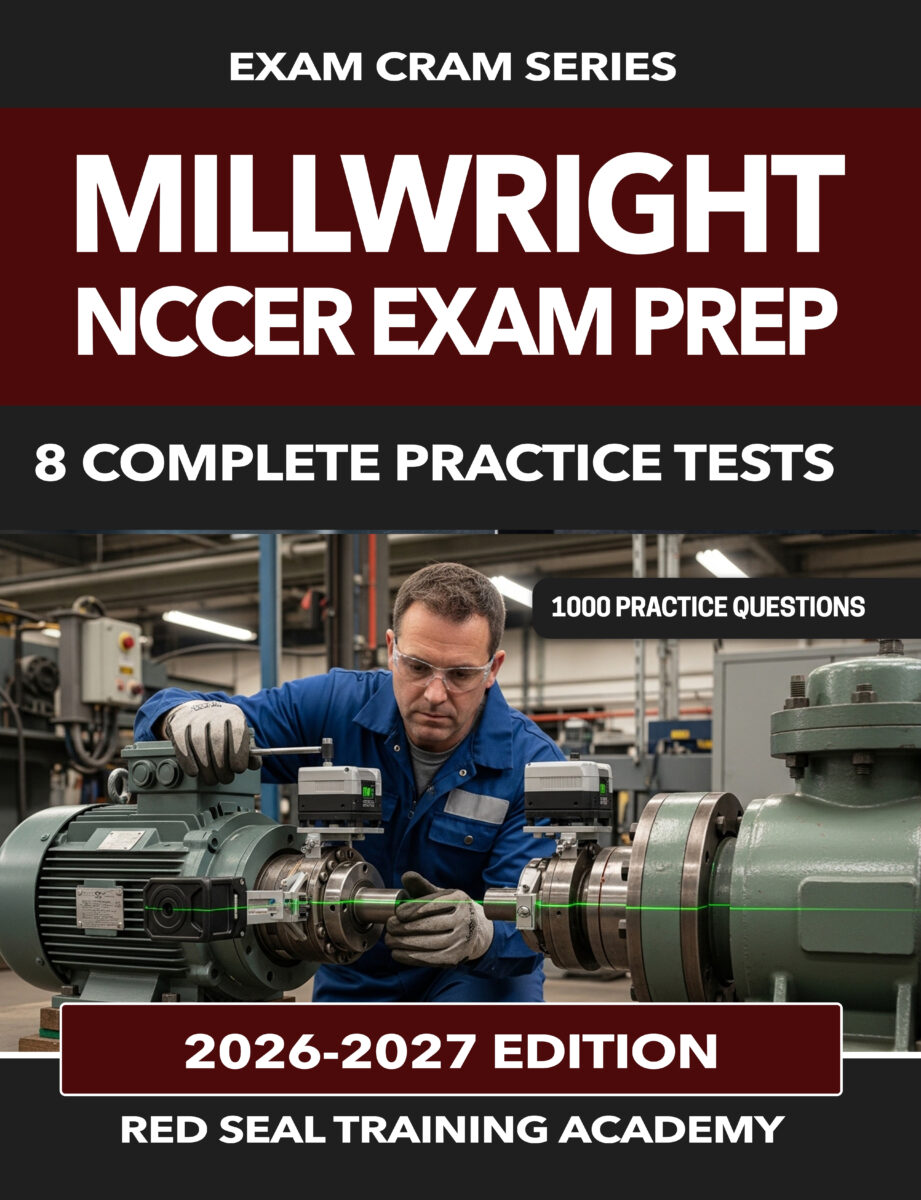
The NCCER Millwright Certification exam is a Module End-of-Course (EOC) or Journey-Level Assessment covering the four-level NCCER Millwright curriculum. The exam is 100 to 140 multiple-choice questions depending on the assessment. The domains below represent the main knowledge areas. Our book follows the same structure so your study time matches the assessment.
| Knowledge Domain / Major Work Activity | Number of Questions |
|---|---|
| Safety, rigging and hoisting Hand and power tools, precision measurement Fasteners, keys, couplings and bearings Shaft alignment and vibration Pumps, compressors and turbines Gearboxes, belt and chain drives Lubrication and bearings Hydraulics, pneumatics and conveyors Total | 18% 10% 14% 12% 12% 10% 8% 16% 100% |
Source: NCCER Millwright Levels 1 through 4 curriculum. Exam length and exact weighting depend on whether the candidate writes the EOC modules or the Journey-Level Assessment. This is a study aid. Red Seal Training Academy is not affiliated with NCCER.
Which Path Are You On?
Apprentice finishing NCCER Level 3 or 4
You are working through the NCCER Millwright curriculum and want to build confidence for your module end-of-course exams. Use our 8 full-length tests to pace yourself and find weak areas.
Journey-Level Assessment candidate
You have the field experience and are preparing for the NCCER Journey-Level Millwright Assessment. Our book covers the breadth of Levels 1–4 so you can close knowledge gaps before the written exam and practical performance verification.
Re-testing after a previous attempt
If your last attempt did not go the way you wanted, use our detailed answer explanations to fix the knowledge gaps, not just memorize answers. Every question in the book has a written explanation.
Try 3 Free Sample Questions
One question of each type you will see on the real exam. Scroll to see the answer and explanation.
1)What is the maximum angle recommended for a two-leg sling lift before sling capacity is significantly reduced?
A. 30 degrees from vertical
B. 45 degrees from vertical
C. 60 degrees from vertical
D. 90 degrees from vertical
Answer: C
Explanation:
As the angle between a sling leg and the vertical increases, the tension on each leg increases. At 60 degrees from vertical (a sling-to-sling angle of 120 degrees), each leg carries approximately 2 times the load share. Industry practice and OSHA rigging guidance recommend keeping sling angles below 60 degrees from vertical to avoid dangerous tension multiplication.
2)When installing a new coupling on a shaft, what is the correct way to heat the coupling for a thermal shrink fit?
A. Heat with an oxyacetylene torch until red-hot
B. Heat evenly in an induction heater or oil bath to the manufacturer’s specified temperature
C. Heat the shaft, not the coupling
D. Do not heat — press on cold
Answer: B
Explanation:
A 2x running speed vibration signature is the classic indicator of misalignment. With bolts still tight, the most likely development is soft foot — the machine has grown thermally, or the foundation has settled, so the machine is no longer sitting flat on all feet. This induces strain and misalignment even when bolts are torqued. Corrective action is to recheck soft foot readings and re-align with shims.
A pump-and-motor assembly was aligned to spec during installation. Three months later, vibration readings show a new misalignment signature at 2x running speed. Mounting bolts are tight. What is the most likely cause?
A. The pump has worn internally
B. Soft foot developed due to thermal growth or settled foundation
C. The coupling has failed
D. The motor bearings are worn
Answer: B
Explanation:
When a 3-phase motor repeatedly trips on overload despite being correctly sized and starting within nameplate, single-phasing is the most common cause. Loss of one phase makes the motor draw much higher current on the remaining two phases, tripping the overload. Verify by checking all three phase voltages at the motor terminals. Welded contacts would prevent the motor from stopping when commanded, not cause overload trips.
Our book has 1,000 questions like these, with an explanation for every one.
Millwright (NCCER) NCCER Exam — Frequently Asked Questions
What is the NCCER Millwright Certification?
The NCCER Millwright Certification recognizes mastery of the four-level NCCER Millwright curriculum. NCCER (National Center for Construction Education and Research) develops standardized craft training used across much of the U.S. construction and industrial workforce. Candidates complete module end-of-course exams during apprenticeship, or sit the Journey-Level Assessment as an experienced worker.
How many questions are on the NCCER Millwright assessment?
Module EOC exams vary by module (typically 25-40 questions each). The Journey-Level Assessment is 100-140 multiple-choice questions, plus a separate practical performance verification in most states and locals.
What is the pass mark?
Most NCCER exams require 70% or higher to pass. The Journey-Level Assessment may require higher scores on specific domains. Confirm with your Accredited Assessment Center.
Can I take the Journey-Level Assessment without completing the full NCCER apprenticeship?
Yes. The Journey-Level Assessment is designed for experienced workers who did not go through a formal NCCER apprenticeship. Candidates typically need documented field experience. Contact an Accredited Assessment Center for the exact requirements.
What is an Accredited Assessment Center?
An Accredited Assessment Center (AAC) is a contractor, training provider, or union local that NCCER has approved to deliver Journey-Level Assessments. You can find your nearest AAC through the NCCER Registry.
Is NCCER certification transferable across states?
Yes. NCCER credentials are nationally recognized across the United States and are also accepted by many contractors in Canada and internationally. Your NCCER training records stay in the NCCER Registry for life.